
Spindle Player Merger & Splitter: Operation Manual & Studio Reference Guide
Version: 1.0.4
Device Classification: Note Player / Routing Utility (Note FX, CV Processor, CV Source)
Rack Format: 1U Full-Width Note Player
Supported Platforms: Reason 10.1 or later (macOS Intel & Apple Silicon Universal, Windows 64-bit)
Author: Edward Boraas
1. Overview & Routing Architecture
Spindle is an 8-to-1 polyphonic Note Player merger, 1-to-8 dual-mode splitter, and bidirectional analog Note + Gate CV bridge built natively for the Reason Rack.
Reason’s Spider Audio Merger & Splitter and Spider CV Merger & Splitter have handled audio and control voltage distribution since the early days of the rack, but Note Players have always been strictly vertical: locked into a single top-to-bottom stack above one instrument. If you wanted one chord generator or sequencer stack to drive three synths, or wanted to combine multiple Player chains into one instrument, you had to duplicate tracks, copy-paste Player stacks, or step down to monophonic Note/Gate CV cables.
Spindle solves that in 1U of rack space. Using SilkLink, an open one-wire polyphonic protocol carried over standard Reason CV cables, Spindle connects any number of Player stacks across the rack with unlimited polyphony, sample-accurate timing, and full controller expression, while also translating to and from standard analog 1V/Oct Note + Gate CV.
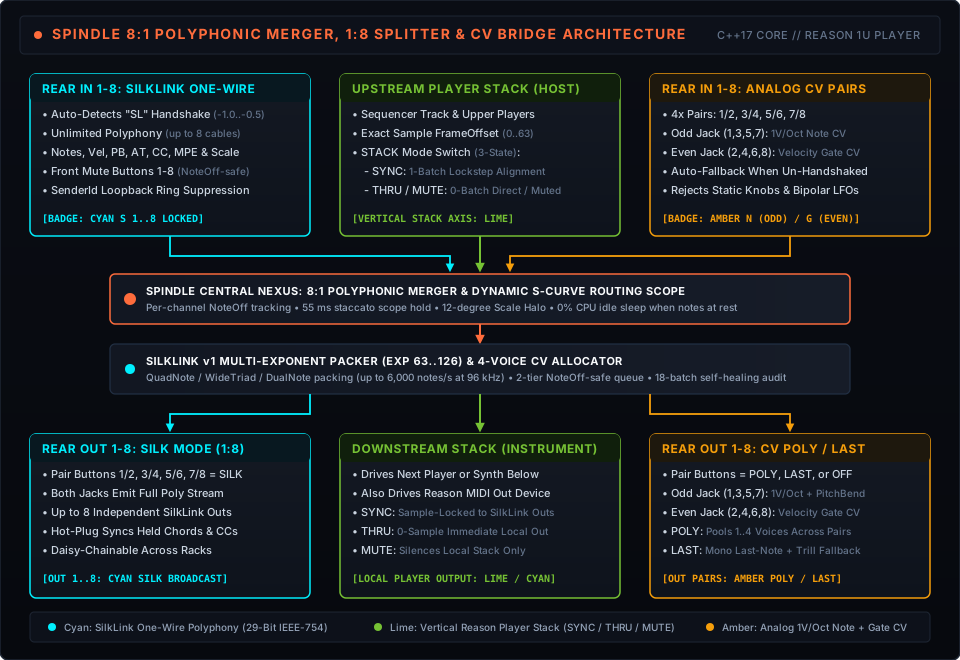
Core Capabilities at a Glance
- One-Wire Polyphonic Player Routing (
SilkLink): Patch a single rear cable from any SpindleSILKoutput (Out 1throughOut 8) into any Spindle input (In 1throughIn 8) to carry unlimited polyphony, velocity, release velocity, pitch bend (channel and per-note MPE), aftertouch (channel and polyphonic), CCs, timbre, microtonal detune, program change, transport sync, and scale metadata across the rack. - Sample-Accurate Stack Synchronization (
STACK: SYNC): Because every Reason CV cable crosses the rack motherboard on a 64-sample batch boundary, Spindle’s defaultSYNCmode holds local vertical Player stack notes by 1 batch (while preserving their exact sub-batch sample offset0..63) whenever a rearSILKoutput is connected. The instrument directly below Spindle and all remoteSilkLinkinstruments trigger on the exact same audio sample. - Zero-Menu Input Auto-Detection: All 8 rear inputs (
In 1throughIn 8) automatically detect whether an incoming cable carries aSilkLinkhandshake (lighting the front/rear badge in cyanS) or standard analog 1V/Oct Note CV on odd jacks (1, 3, 5, 7, amberN) paired with Gate CV on even jacks (2, 4, 6, 8, amberG). - 4-Mode Output Pairs (
SILK / POLY / LAST / OFF): Each of the four output pairs (1/2,3/4,5/6,7/8) switches independently between dual one-wireSilkLinkbroadcast (SILK), 1-to-4 voice polyphonic analog Note + Gate CV allocation (POLY), monophonic last-note priority analog Note + Gate CV (LAST), or muted (OFF).
2. Front-Panel Guided Tour
Spindle’s 1U front panel is organized from left to right following the signal path: master power and vertical stack control in Bay 1, the 8-channel input merger in Bay 2, the real-time vector routing scope in Bay 3, and the 4-pair output splitter in Bay 4.

2.1 Bay 1: Power & 3-State STACK Control (“Down and Through” Tap)
POWER(ON/OFF, defaultON): Master Player bypass toggle. When set toOFF(or when the Player chain is bypassed in the rack header), Spindle releases any active rear-input or CV voices cleanly and passes upstream Player notes straight down to the local instrument.STACK(SYNC/THRU/MUTE, defaultSYNC, MIDI CC 14): As shown by the front-panel schematic trace (which branches off to the merger/splitter bus before the switch and passes vertically down to the local instrument after the switch), clickingSTACKcycles through three vertical routing modes (Shift + Clicksteps in reverse;Cmd/Ctrl + Clickresets toSYNC):SYNC(Cyan, Default): Aligns vertical output to the local instrument with active rearSILKoutputs. When at least one rearSILKoutput jack is connected, upstream Player notes pass through the exact sameSilkLinkframe-packing queue (QuadNote/WideTriadNote/DualNote) as the rearSilkLinkoutputs so the local downstream instrument and all remoteSilkLinkinstruments trigger on the exact same audio sample (0.00 msskew, zero comb-filtering). When no rearSILKoutputs are connected,SYNCruns direct with 0-sample delay.THRU(Lime Green): Passes upstream Player notes straight down to the local instrument with 0-sample delay regardless of rear cabling, while simultaneously feeding the merger, scope, and rear outputs.MUTE(Dim Slate): Silences all vertical output to the local Player stack and instrument directly below Spindle (blocking notes from both upstream Players and rear inputsIn 1throughIn 8), while the pre-switch tap continues merging and routing upstream Player and rear-input notes into the Routing Scope and out all rear jacks (SILK,POLY, andLAST). Switching toMUTEwhile holding a chord immediately sendsNoteOffevents down the local stack so notes never hang.
2.2 Bay 2: 8:1 Dual-Mode Input Merger (IN 1 to IN 8)
Each of the 8 input channels pairs an upper Auto-Detect Status Badge (S 1•N through S 8•G) with a lower ON / OFF Channel Enable Button (MIDI CC 20 to 27):
- Upper Status Badges (
S 1•N,S 2•G..S 7•N,S 8•G):- Unplugged (Dim Slate): No cable is patched into the corresponding rear
Injack. - Cyan
S(SilkLinkLocked): The rear jack has locked onto an incomingSilkLinkone-wire polyphonic stream. Every jack (1through8) can accept an independentSilkLinkcable. - Amber
N(Odd Jacks1, 3, 5, 7) / AmberG(Even Jacks2, 4, 6, 8): An un-handshaked analog CV cable is connected. Odd inputs read 1V/Oct Pitch CV (0.0to1.0= MIDI notes0to127), and even inputs read velocity-sensitive Gate CV (> 0.0triggers Note On with velocity scaled from1to127;<= 0.0triggers Note Off).
- Unplugged (Dim Slate): No cable is patched into the corresponding rear
- Lower
ON/OFFChannel Buttons (1to8, defaultON):- Click any button to mute (
OFF) or enable (ON) that input channel. - In
SilkLinkmode, muting a channel (1through8) immediately sendsNoteOfffor any notes currently held by that specific input stream without disturbing notes held by other channels or the upstream stack. - In analog Note + Gate CV mode, muting either the odd (
Note) or even (Gate) button of a pair (1/2,3/4,5/6,7/8) cleanly closes that analog CV voice.
- Click any button to mute (
2.3 Bay 3: Dynamic S-Curve Routing Scope
The center OLED display renders a live vector graph of your active routing topology:
- Left S-Curves (Inputs
1to8): Only connected input jacks are drawn, automatically balancing themselves vertically around the center hub. Cyan curves represent lockedSilkLinkinputs; amber curves represent analog CV inputs; dim slate curves indicate muted channels. - Vertical Axis (Local
STACK): The upper vertical stem appears whenever an upstream Player or sequencer track feeds notes into Spindle from above (glowing lime green when upstream notes arrive). The lower vertical stem shows output flowing down to the local instrument below (colored cyan inSYNCmode, lime green inTHRUmode, or hidden inMUTEmode). - Right S-Curves (Outputs
1to8): Connected rear output jacks fan out to the right, colored cyan for pairs set toSILK, amber for pairs set toPOLYorLAST, and dim slate for pairs set toOFF. - 55 ms Staccato Pulse Hold & 0% Idle Sleep: Active traces stay lit for the entire duration of sustained notes and hold for a minimum of 55 ms on ultra-short staccato triggers so fast arpeggios and drum gates remain clearly visible. When all notes are at rest, the scope parks statically at 0% idle CPU.
- 12-Degree Scale Halo: Whenever an upstream Player or
SilkLinkinput transmits a non-chromatic scale mask, a 12-dot circular halo appears around the central hub (with 12 o’clock marking the root pitch class in tangerine and active scale degrees lit in cyan).
2.4 Bay 4: 1:8 Dual-Mode Output Splitter (1/2, 3/4, 5/6, 7/8)
Four wide mode buttons (MIDI CC 28 to 31) control the four rear output jack pairs (Out 1/2, Out 3/4, Out 5/6, Out 7/8). Click any button to cycle forward through the four modes, or Shift + Click to cycle backward:
SILK(CyanS1 S2..S7 S8, Default): Both the odd and even jacks of the pair transmit the full mergedSilkLinkpolyphonic stream. With all four pairs set toSILK, Spindle provides 8 identicalSilkLinkoutputs (Out 1throughOut 8).POLY(Amber1•N 2•G..7•N 8•G): Assigns the pair to Spindle’s Polyphonic Analog CV Voice Pool. The odd jack outputs 1V/Oct Note CV (including live pitch-bend offsets) and the even jack outputs velocity-scaled Gate CV (velocity / 127.0). Whichever output pairs are set toPOLY(from 1 to 4 pairs) automatically pool together to allocate 1, 2, 3, or 4 simultaneous chord voices.LAST(Amber1•N 2•G..7•N 8•G): Configures the pair as an independent Monophonic Last-Note Priority analog CV output (odd jack = 1V/Oct Note CV + pitch bend, even jack = velocity-scaled Gate CV). Playing a new note while holding an older key smoothly steps Pitch CV to the new note; releasing the newest key while older keys remain held trills back to the most recent still-held note.OFF(Dim Slate): Silences both jacks of the pair (0.0 V) and releases any notes allocated to them.
3. Rear-Panel Patchbay & Auto-Detection
Flip the rack (Tab) to access Spindle’s 16 rear CV sockets (8 inputs on the left, 8 outputs on the right) alongside mirrored status badges and clickable output pair mode switches.

3.1 How Input Auto-Detection Works (In 1 to In 8)
You never have to flip an input mode switch when patching cables into In 1 through In 8:
SilkLinkDetection (Any Input1to8): When you patch aSilkLinkoutput from another Spindle (or anySilkLink-compatible device) into any inputIn 1throughIn 8, the transmitter sends a 2-batch negative floating-point handshake ("SL"magic signature0x297Ain the-1.0to-0.5range). The input locks ontoSilkLinkimmediately and lights itsSbadge in cyan.- Analog Note + Gate CV Fallback (Pairs
1/2,3/4,5/6,7/8): When a cable is patched into an even Gate jack (In 2,In 4,In 6, orIn 8) without aSilkLinkhandshake, Spindle treats that odd/even pair as a standard Reason analog CV pair:- Odd Jack (
In 1, 3, 5, 7): 1V/Oct Pitch CV (Note = round(CV * 127.0)). If only the even Gate jack is patched and the odd Note jack is left unpatched, Spindle defaults the trigger pitch to Middle C (C3, MIDI note60) for drum and percussion gating. - Even Jack (
In 2, 4, 6, 8): Gate CV (> 0.0triggers a note withVelocity = clamp(round(Gate * 127.0), 1, 127)).
- Odd Jack (
- 2-Pass Cross-Pair Matcher: Because each of the 8 inputs runs its own
SilkLinkdetector, you can mixSilkLinkcables and analog CV cables freely. If an odd jack (In 1) is occupied by aSilkLinkcable while you patch an analog Gate intoIn 2and an analog Note intoIn 3, Spindle’s 2-pass matcher automatically pairs the orphaned analog Note and Gate across adjacent pairs. - Analog LFO & Static Knob Immunity: Standard bipolar LFOs, audio-rate signals, and static positive CV knobs never produce the
"SL"handshake signature (0x297Ain-1.0..-0.5), and locked inputs are supervised by a 4-batch static-positive watchdog. Patching a random LFO or knob into an input jack won’t falsify aSilkLinklock or trigger stray notes.
3.2 Live Mode-Switch Unlock & Hot-Plug Sync
- Switching an Output Pair from
SILKtoPOLY/LAST/OFF: If a rear output is currently locked to a downstream Spindle inSILKmode and you click the output pair button to switch it toPOLY,LAST, orOFF, the transmitting Spindle automatically emits a 1-batch unlock pulse before switching to analog CV voltages. The downstream Spindle immediately unlocks fromSilkLink(1.3 msat 48 kHz) and releases any held notes so analog Note CV voltages[0.5, 1.0)are never mistaken forSilkLinkframes. - Hot-Plugging a Cable While Holding a Chord: When a rear
SILKoutput jack detects a new cable connection (connectedrising edge), Spindle automatically sends a fresh 2-batch"SL"handshake followed by the currently held notes (preserving their exact 7-bit velocities) and any touched controllers (Pitch Bend, Mod Wheel, Aftertouch, Sustain, Scale), bringing the newly connected receiver into immediate harmonic lock.
4. Six Studio Routing Topologies & Combinator 2 Workflows
4.1 Multi-Synth Unison Layering (Sample-Accurate SYNC)
Stacking a sub-bass, an analog brass pad, and a physical-modeling pluck on the same chord progression usually requires duplicating tracks or cramming all three instruments into a single Combinator (where they all have to share the exact same Player chain).
- Setup: Place Spindle #1 below the master Player chain on Synth 1 (
STACK=SYNC). Place Spindle #2 above Synth 2 and Spindle #3 above Synth 3. PatchOut 1andOut 2(SILK) from Spindle #1 toIn 1on Spindle #2 and Spindle #3. - Why It Works: Because Spindle #1 is in
SYNCmode, it passes Synth 1’s local vertical notes through the same frame-packing queue asOut 1andOut 2. All three synths receive every note on the exact same sample (0.00 msskew).
4.2 Harmonic Tree Branching (Master Chords to Independent Child Players)
To keep an entire arrangement locked to one live chord progression while each instrument plays its own rhythm:
- Setup: Place Spindle #1 directly below Scales & Chords (or Chord Sequencer) on Track 1. Patch
Out 1(SILK) to Spindle #2 placed above a Bassline Generator or monophonic RPG-8 on your bass track, and patchOut 2(SILK) to Spindle #3 placed above a Dual Arpeggio on your lead track. - Result: Changing a single chord in Track 1 updates the pad, bassline, and arpeggio across the rack simultaneously.
4.3 Simultaneous In-Rack Instrument + External Hardware (MIDI Out)
Reason’s MIDI Out device sits in an instrument slot, which means a Player stack normally can’t drive both an in-rack synth and a MIDI Out device on the same track.
- Hardware Synth Unison: Put Spindle #1 at the bottom of your synth track’s Player stack (
STACK=SYNCorTHRU), drop a MIDI Out device anywhere in the rack with Spindle #2 stacked above it, and run oneSILKcable from Spindle #1Out 1to Spindle #2In 1. - 8-Track External MIDI Bus Concentrator: Drop a Concentrator Spindle above a MIDI Out device routed to an external synth, modular MIDI-to-CV interface, or standalone VST/AU host, and patch
Out 1(SILK) from up to 8 instrument tracks’ Spindles intoIn 1throughIn 8. Toggle the front-panelONbuttons (1through8) to choose which tracks feed that external MIDI port on the fly without stuck notes.
4.4 8-Channel Generative Player Mixer & Live Mute Matrix
- Setup: Route up to 8 different generative Player chains (or Euclidean/step sequencers) into
In 1throughIn 8on a master Spindle sitting above a drum kit (Kong / Umpf) or multi-layered Combinator. - Combinator 2 Performance Mapping: Inside a Combinator 2, map eight front-panel Combi buttons to Spindle’s
Link In 1throughLink In 8(ChEnable_1..8). Toggling any button mutes that incoming pattern and immediately sends reference-countedNoteOffevents for any notes currently held on that channel.
4.5 Daisy-Chaining for 1-to-15+ Rack-Wide Fan-Out
A single Spindle provides 8 rear SILK outputs (Out 1 through Out 8) plus its vertical STACK output (9 destinations total). If you need to fan out to even more instruments, patch Out 8 (SILK) into In 1 on a second Spindle to add 7 more SilkLink outputs (15 rear outputs total), and so on. Each hop adds 1 audio batch (64 samples, ~1.33 ms at 48 kHz) of motherboard transit.
4.6 4-Voice Polyphonic Analog CV Polychaining (CV POLY)
Legacy CV instruments, modular Rack Extensions (Complex-1, SubTractor, Monotone), and effect key-trackers (Sweeper, ECF-42, Pulveriser) rely on analog 1V/Oct Note CV and Gate CV.
- Setup: Set any
1..4output pairs (1/2,3/4,5/6,7/8) toPOLY. - Voice Allocation Rules:
- Zero Voice-Hopping & Released-Pitch Hold: When a chord key is released, its Gate CV drops to
0.0 Vwhile itsNote CVjack continues holding the released pitch so long amp-envelope release tails ring out at the proper pitch without jumping. - Same-Pitch Re-Use & Free Voice Allocation: Re-striking a pitch re-uses its assigned voice slot; new notes claim idle voices in the
POLYpool cleanly. - Oldest-Voice Stealing & Held-Note Backfill: Holding more than N notes steals the oldest active voice; releasing that stolen voice while the earlier key is still held automatically backfills the still-held note.
- Pitch-Bend Integration: Incoming MIDI or
SilkLinkPitch Bend (±2 semitones range) is continuously added into the 1V/Oct Note CV float on all activePOLYandLASTodd output jacks.
- Zero Voice-Hopping & Released-Pitch Hold: When a chord key is released, its Gate CV drops to
5. Under the Hood: The SilkLink v1 Protocol & DSP Reference
For engineers and fellow Rack Extension developers who want the exact math behind the faceplate: Spindle’s DSP engine (dsp/SpindleCore.h, SpindleTxEngine.h, SpindleVoiceEngine.h) and the open MIT-licensed SilkLink v1 SDK (SilkLinkCodec.h, SilkLinkEndpoint.h, SilkLinkJukebox.h) are written in standard ISO C++17 with zero host allocations on the audio thread.
5.1 Sign-Split 32-Bit IEEE-754 Floating-Point Framing
Every Reason CV cable carries one lossless 32-bit IEEE-754 floating-point value (float ↔ double in host memory) per 64-sample audio batch (fbatch = fs / 64: 689.06 Hz at 44.1 kHz, 750.0 Hz at 48 kHz, 1,500.0 Hz at 96 kHz). Standard unmodulated Note/Gate CV signals sit in [0.0, +1.0].
SilkLink v1 partitions the IEEE-754 float space by sign and exponent (e6 = 126 - Exp, e5 = e6 >> 1) so data frames never collide with subnormals, NaN, ±Inf, or Reason’s motherboard range:
0xBF000000 | M23)Positive Multi-Exponent Event Space: v ∈ [2−64, 1.0), Sign = 0, Exp ∈ [63, 126] (
e6 [6b] + M23 [23b] = 29 bits/batch)
Across all positive event frames (Exp 63..126), e6 & 1 pairs adjacent exponents (126 ↔ 125, 124 ↔ 123, …, 64 ↔ 63) into 32 logical frame families (e5 ∈ [0, 31]) and serves as a universal 1-bit hardware anti-collision toggle alongside intra-mantissa toggles. Consecutive identical events always produce bitwise-distinct IEEE-754 floats on the Reason motherboard wire with zero spacer batches, yielding 28 usable data payload bits per batch (5-bit e5 + 23-bit mantissa).
5.2 Multi-Exponent Chord Packing (e5 = 1..31) & Standard Opcode Framing (e5 == 0)
When multiple notes arrive in the same 64-sample batch (such as a block chord from Scales & Chords or a strum), SilkLink automatically packs up to 4 simultaneous notes into a single batch across Exp 63..124 (e5 = 1..31), while e5 == 0 (Exp 126 / anti-collision Exp 125) carries 8 primary 3-bit opcodes (Opcode 0..7) with a 20-bit payload:
| Frame Class | IEEE-754 Exponent (e5) | Bit Allocation (5-bit e5 + 23-bit Mantissa M23 = 28 Payload Bits) | Peak Note Rate (44.1 / 48 / 96 kHz) |
|---|---|---|---|
QuadNote (4-Note Chord On/Off) | Exp 95..108 (e5 = 9..15) | 14b Header (u14 = ((e5 - 9) << 11) + M23[22:12] = Vel7 × 112 + Root) + 3 × 4b Intervals (1..16 semitones) | 2,756 / 3,000 / 6,000 notes/s |
WideTriadNote (Any 3-Note Chord) | Exp 109..124 (e5 = 1..8) | 7b Shared Vel (0..127) + 19b Reflection Bijection (idx19 mapping any sorted triad 0 <= n0 < n1 < n2 <= 127) | 2,067 / 2,250 / 4,500 notes/s |
DualNoteIndVel (2-Note Ind. Vel) | Exp 63..94 (e5 = 16..31) | 7b VelLo (1..127) + 7b VelHi (1..127) + 13b Triangle Bijection (pair13 for 0 <= nLo < nHi <= 127) | 1,378 / 1,500 / 3,000 notes/s |
e5 == 0 Primary Opcodes (0..7) | Exp 126 / 125 (e5 = 0) | 3b Opcode (0: NoteOff, 1: NoteOn, 2: ControlSystem, 3: DualNoteOff, 4/5: DualNoteOn, 6: TriadNote, 7: Extension7) + 20b Payload | 689 / 750 / 1,500 frames/s |
Even at 44.1 kHz, QuadNote chord framing achieves 2,756 notes/sec over a single CV cable, exceeding the theoretical ceiling of a hardware 31.25 kbps 5-pin MIDI 1.0 cable (~1,041 notes/sec, or ~1,388 notes/sec with running status) by more than 2x.
5.3 Sub-Batch Sample Offset Preservation (FrameIndex 0..63)
Single NoteOn (Opcode 1) and NoteOff (Opcode 0) frames in e5 == 0 encode the exact 6-bit sample offset (frameIndex ∈ [0, 63]) alongside the full 7-bit note number and 7-bit velocity (ReleaseTag on NoteOff):
When a receiving Spindle decodes a single note frame (or aligns an upstream local stack note by 1 batch in SYNC mode), it writes that exact frameIndex (0..63) onto Reason’s note output bus, preserving sub-millisecond groove and humanization timing to the exact sample across the rack (DualNoteOn also preserves a 1-bit half-batch offset frame = 0 vs 32 via pitch ordering).
5.4 Extended Expression: ControlSystem (SubOps 0..13) & Extension7
Within e5 == 0, Opcode 2 (ControlSystem) and Opcode 7 (Extension7) provide a complete vocabulary for channel, polyphonic, MPE, microtonal, and 14-bit modulation routing:
ControlSystem(Opcode 2,4-bit SubOpinM23[19:16]+16-bit PayloadinM23[15:0]):SubOp 0(AllNotesOff): Panic / transport reset / cable disconnect flush (6b FrameIndex, ring-convergent TX suppression).SubOp 1(PitchBend14): Standard14-bitMIDI Pitch Bend (0..16383, center8192).SubOp 2(ControlChange7): Standard7-bitMIDI Control Change (7b CC#+7b Value;CC 64..69&120..127ride the high-priority discrete tier).SubOp 3(ChannelPressure): Monophonic Channel Aftertouch (6b FrameIndex+7b Pressure).SubOp 4(ScaleMetadata): Key/scale broadcast (4b Root 0..11+12b Pitch-Class Mask).SubOp 5(PolyAftertouch): Per-note Polyphonic Key Pressure (7b Note+7b Pressure).SubOp 6(ProgramChange): Bank + Program / Pattern select (7b Bank+7b Program,16,384slots).SubOp 7(StepClockSync): Sample-accurate sequencer step phase lock (6b FrameIndex+8b StepIndex).SubOp 8(NotePitchBend): Per-note MPE pitch bend (7b Note+7b Bipolar Bend, center64).SubOp 9(NoteTimbre): Per-note MPE Slide / CC 74 (7b Note+7b Timbre).SubOp 10(ReleaseVelocity): Per-note key-off release velocity (7b Note+7b Release Velocity).SubOp 11(TransportSync): Transport flags (Play,Reset,BarStart,LoopWrap),4b TimeSigDiv, and6b FrameIndex.SubOp 12(MicrotonalDetune): Per-note microtonal offset (7b Note+7b Signed Cents,-50..+50cents).SubOp 13(ActiveChannel): Multi-timbral group (0..15), MIDI channel (0..15), and6b FrameIndex.
Extension7(Opcode 7,20-bit Canonical Extension PayloadinM23[19:0]):HiResMod14(Bit 19 == 0): 32-Slot 14-Bit Hi-Res Modulation Bus (5b ModSlot 0..31+14b Value 0..16383), coalesced per slot and replayed on hot-plug.ChannelNote(Bits 19..18 == 0b10): 16-Channel Multi-Timbral Note Event (4b Channel 0..15+7b Note+7b Velocity,0=NoteOff).MicroNoteOn(Bits 19..18 == 0b11): Microtonal FractionalNoteOn(5b SubSemitone 0..31[3.125-cent steps] +7b Note+6b Velocity).
5.5 Two-Tier Priority Queue, 18-Batch Self-Healing Audit & 0 Hz Idle Quiescence
- Unified 256-Slot Two-Tier Priority Queue: Discrete musical events (
NoteOn,NoteOff, packed chords,AllNotesOff, switch pedalsCC 64..69,ScaleMetadata,ProgramChange,StepClockSync,ChannelNote,MicroNoteOn) automatically leapfrog queued continuous controller frames (PitchBend14, continuousCCs,Aftertouch,MPE,HiResMod14), which coalesce in-place per target. Under extreme saturation (> 256simultaneous queued words), overflow eviction drops continuous controllers first andNoteOnframes second, never droppingNoteOfforAllNotesOffframes so notes can never hang. - Bounded 18-Batch Self-Healing Note Audit (
Exp 126Negative Carrier): Immediately after any note transition or hot-plug, Spindle emits 2"SL"handshake beacons (0x297A) followed by a 16-slice active-note audit sweep (0x5Amagic +4b SenderId+4b SliceIdx 0..15+8b SliceMask) across all 128 MIDI notes in(-1.0, -0.5], healing any missed note transition within ~24 ms at 48 kHz. 0 HzMotherboard Quiescence at Rest & Sustained Hold: Once the 18-batch audit sweep completes, the output parks on a single constantIdleCarrierfloat both at rest and during sustained chords. Because Reason’s motherboard only wakes downstream CV listeners when a socket value changes, parkedSilkLinkcables generate 0 Hz of steady-state motherboard wakeups.
6. Technical Specifications
| Specification | Value / Details |
|---|---|
| Product ID & Format | ca.boraas.Spindle • 1U Note Player Rack Extension (patchless utility) |
| One-Wire Protocol | SilkLink v1 (Sign-split multi-exponent 29-bit IEEE-754 floating-point framing) |
| Peak Note Throughput | 2,756 notes/sec at 44.1 kHz • 3,000 notes/sec at 48 kHz • 6,000 notes/sec at 96 kHz • 12,000 notes/sec at 192 kHz |
| Sub-Batch Timing Resolution | Sample-accurate (FrameIndex 0..63 preserved on single note events and SYNC stack delay) |
Rear Inputs (In 1 to In 8) | 8 Auto-detecting inputs: SilkLink one-wire polyphony on any jack 1..8, or up to 4 analog 1V/Oct Note CV (odd jacks 1, 3, 5, 7) + Velocity Gate CV (even jacks 2, 4, 6, 8) pairs |
Vertical STACK Modes | SYNC (default, 1-batch lockstep alignment with active SILK outputs), THRU (0-sample direct pass-through), MUTE (all local vertical stack output muted) |
Rear Outputs (Out 1 to Out 8) | 4 independently switchable pairs (1/2, 3/4, 5/6, 7/8): SILK (dual one-wire polyphonic outputs, up to 8 total), POLY (1-to-4 voice polyphonic Note + Gate CV pool), LAST (monophonic last-note priority Note + Gate CV), OFF |
| Analog Pitch & Gate Standard | Odd jack: 1V/Oct linear Pitch CV (0.0..1.0 = MIDI 0..127 + live ±2 semitone Pitch Bend) • Even jack: Velocity-scaled Gate CV (0.0..1.0 = Velocity 0..127) |
| Event Queue Architecture | 256-slot two-tier priority queue: discrete note/switch events leapfrog in-place coalescing continuous controllers (NoteOff-safe overflow eviction) |
| Loop & Fault Protection | Connect-time "SL" magic handshake (0x297A), TX-window + SenderId self-loop and closed-ring (AllNotesOff / note / controller) echo suppression, and 18-batch self-healing 128-note audit |
| Supported Sample Rates | 22.05 kHz to 192.0 kHz |
| Host Requirements | Reason 10.1 or later (Standalone DAW or Reason Rack Plugin VST3/AU/AAX on macOS & Windows) |
7. Reason Remote & MIDI CC Implementation Chart
All front-panel switches and real-time telemetry properties are exposed to Reason Remote, Combinator 2 Programmer mapping, and MIDI CC automation:
| Property Path | Remote Internal Name | Short / Shortest | MIDI CC | Range / States | Default |
|---|---|---|---|---|---|
/custom_properties/OnOff | On/Off | On/Off / OnOf | — | Off (0), On (1) | On |
/custom_properties/StackThru | Stack Thru | StkThru / Thru | CC 14 | Muted (0), Pass-Through (1), Auto Link-Sync (2) | Auto Link-Sync (SYNC) |
/custom_properties/CvGateEnable | CV Bridge | CVBridge / CVBr | CC 15 | Off (0), On (1) | On |
/custom_properties/ChEnable_1 | Link In 1 | LinkIn 1 / Lnk1 | CC 20 | Muted (0), Active (1) | Active (ON) |
/custom_properties/ChEnable_2 | Link In 2 | LinkIn 2 / Lnk2 | CC 21 | Muted (0), Active (1) | Active (ON) |
/custom_properties/ChEnable_3 | Link In 3 | LinkIn 3 / Lnk3 | CC 22 | Muted (0), Active (1) | Active (ON) |
/custom_properties/ChEnable_4 | Link In 4 | LinkIn 4 / Lnk4 | CC 23 | Muted (0), Active (1) | Active (ON) |
/custom_properties/ChEnable_5 | Link In 5 | LinkIn 5 / Lnk5 | CC 24 | Muted (0), Active (1) | Active (ON) |
/custom_properties/ChEnable_6 | Link In 6 | LinkIn 6 / Lnk6 | CC 25 | Muted (0), Active (1) | Active (ON) |
/custom_properties/ChEnable_7 | Link In 7 | LinkIn 7 / Lnk7 | CC 26 | Muted (0), Active (1) | Active (ON) |
/custom_properties/ChEnable_8 | Link In 8 | LinkIn 8 / Lnk8 | CC 27 | Muted (0), Active (1) | Active (ON) |
/custom_properties/OutPairMode_1 | Out 1/2 Mode | Out 1/2 / Ot12 | CC 28 | Muted (0), CV Last-Note Priority (1), CV Poly Voice-Split (2), SilkLink Polyphonic (3) | SilkLink Polyphonic (SILK) |
/custom_properties/OutPairMode_2 | Out 3/4 Mode | Out 3/4 / Ot34 | CC 29 | Muted (0), CV Last-Note Priority (1), CV Poly Voice-Split (2), SilkLink Polyphonic (3) | SilkLink Polyphonic (SILK) |
/custom_properties/OutPairMode_3 | Out 5/6 Mode | Out 5/6 / Ot56 | CC 30 | Muted (0), CV Last-Note Priority (1), CV Poly Voice-Split (2), SilkLink Polyphonic (3) | SilkLink Polyphonic (SILK) |
/custom_properties/OutPairMode_4 | Out 7/8 Mode | Out 7/8 / Ot78 | CC 31 | Muted (0), CV Last-Note Priority (1), CV Poly Voice-Split (2), SilkLink Polyphonic (3) | SilkLink Polyphonic (SILK) |
/custom_properties/ActiveNote | Active Note | ActNote / Note | — | 0..127 (Read-Only Telemetry) | 0 |
/custom_properties/ActiveVelocity | Active Vel | ActVel / Vel | — | 0..127 (Read-Only Telemetry) | 0 |
/custom_properties/ActiveGate | Active Gate | ActGate / Gate | — | Off (0), On (1) (Read-Only Telemetry) | Off |
/custom_properties/LinkLockMask | Link Lock Mask | LockMask / Lock | — | 0..255 8-bit SilkLink lock bitmask (Read-Only) | 0 |
/custom_properties/LinkConnectedMask | Link Connected Mask | ConnMask / Conn | — | 0..255 8-bit input cable bitmask (Read-Only) | 0 |
/custom_properties/LinkActiveMask | Link Active Mask | ActvMask / Actv | — | 0..1023 10-bit activity bitmask (Read-Only) | 0 |
/custom_properties/LinkOutConnectedMask | Link Out Connected Mask | OutCnMsk / OtCn | — | 0..255 8-bit output cable bitmask (Read-Only) | 0 |
/custom_properties/ActiveScaleRoot | Active Scale Root | SclRoot / ScRt | — | 0..11 Pitch class root C..B (Read-Only) | 0 |
/custom_properties/ActiveScaleMask | Active Scale Mask | SclMask / ScMk | — | 0..4095 12-bit scale degree mask (Read-Only) | 4095 |